Immediate Direct Answer: How Small Businesses Scale Operations with AI Agents
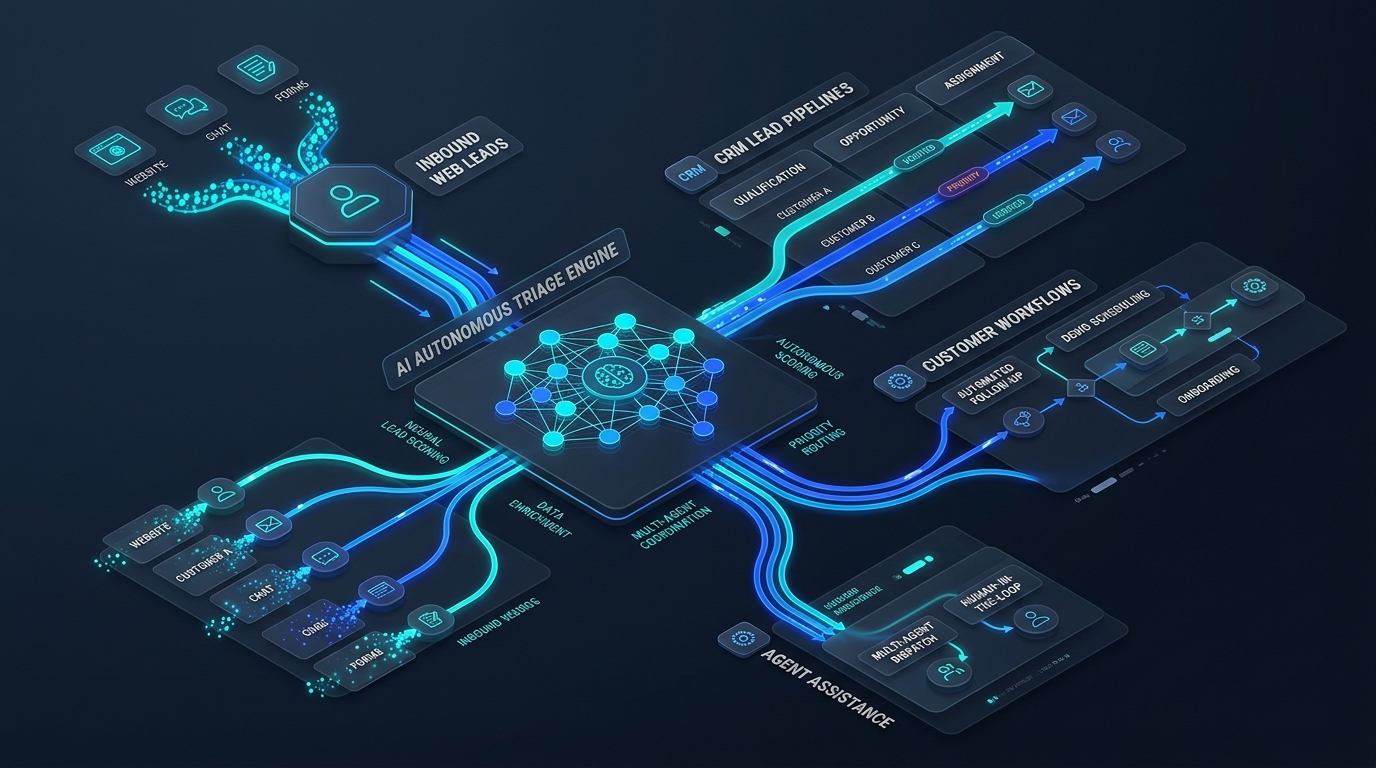
Small businesses scale operations using AI agents by automating asynchronous execution—specifically multi-step lead triage, receipt reconciliation, and ticket resolution across external APIs without human bottlenecks. Unlike basic chatbots that merely generate conversational text, autonomous AI agents perceive triggers, evaluate business constraints via LLM reasoning engines, and execute deterministic read/write API actions across CRMs, accounting systems, and communication channels. This reduces lead response times from 4 hours to under 15 seconds and cuts operational overhead by up to 60% within 30 days.
4 Concrete Production Workflows for Small Businesses
To achieve immediate payback, small business operators deploy AI agents across four high-friction, repetitive workflows:
1. Inbound Triage & 15-Second WhatsApp Qualification
Responding within minutes dictates modern sales conversion rates. An autonomous inbound sales agent monitors web forms, incoming emails, and Meta ads 24/7/365.
- Trigger: A prospective client submits a consultation request or initiates a WhatsApp conversation.
- Reasoning & Validation: The agent retrieves prospect company details via Clearbit/Apollo API, evaluates budget fit against ideal customer profile (ICP) criteria, and detects intent using Bland AI or Voiceflow logic.
- Autonomous Execution: The agent sends a personalized WhatsApp message within 15 seconds, answers preliminary technical questions using verified knowledge base embeddings, checks Google Calendar availability, and pushes the qualified opportunity into HubSpot.
2. Automated Bookkeeping & Receipt Reconciliation
Manual data entry across vendor bills and purchase orders costs an estimated $12 to $25 per invoice in staff labor. Document intelligence agents ingest multi-format PDFs, extract line items with OCR sub-millimeter precision, verify totals against existing ERP records (QuickBooks or Xero), flag anomaly discrepancy thresholds, and stage approved payouts for one-click executive authorization.
3. Autonomous Tier-1 / Tier-2 Customer Support Resolution
Over 70% of inbound customer inquiries across retail, professional services, and field operations involve repetitive informational lookups: order status, appointment rescheduling, warranty verification, or standard pricing inquiries. A customer service AI agent integrates directly with Zendesk, Freshdesk, or custom SQL databases via Chatbase / RAG embeddings to autonomously authenticate customer identity, fetch live tracking details, modify appointment slots, and resolve tickets instantly.
4. Outbound Pipeline Scraping & Personalized Enrichment
Manual prospect research consumes 15 to 20 hours per week for sales reps. An autonomous outbound agent listens to Apollo webhooks for newly funded companies or verified buyer signals, enriches company news via Claude 3.5 Sonnet API, drafts hyper-personalized follow-up emails highlighting relevant case studies, and stages drafts directly in the sales director’s inbox.
Operations Payback & Time Saved Benchmark Table
Step-by-Step Implementation Roadmap for Founders
- Audit Friction & Task Repetition: Identify tasks consuming more than 10 hours per week across your team that follow clear operational logic and interact with accessible software APIs.
- Standardize Business Knowledge: Structure standard operating procedures (SOPs), pricing guidelines, and service boundaries into clean markdown or vector-ready documentation.
- Build in a Sandboxed Orchestration Layer: Connect visual orchestration nodes (such as self-hosted n8n or Make enterprise) to isolated staging APIs.
- Implement Human-in-the-Loop Safeguards: Enforce strict confidence thresholds. If model certainty dips below 92%, route the task to a human supervisor with pre-drafted context.
Explore our specialized Enterprise AI Automation & Agent Engineering services to architect custom agentic infrastructure tailored to your commercial workflow, or review our Custom Software Development capabilities for bespoke API integrations.
Frequently Asked Questions (FAQ)
What exactly is an AI agent in a small business context?
An AI agent is an autonomous software program that uses artificial intelligence to perceive inputs, make contextual decisions based on business rules, and execute multi-step tasks across external software applications (like CRMs, databases, and communication channels) without requiring continuous human management.
How fast can a small business deploy its first AI agent?
A standard single-purpose AI agent—such as a 15-second WhatsApp lead qualification bot or customer support triage agent—can be designed, integrated, and fully deployed into production within 7 to 14 business days when using modular orchestration platforms.
Do I need in-house developers or engineers to maintain AI agents?
No. Modern agent architectures utilize visual orchestration systems (like n8n and Make) alongside enterprise API gateways. Operations managers can adjust prompts, knowledge documents, and routing rules without writing low-level code, while specialized development agencies provide ongoing architectural monitoring.
How do AI agents prevent hallucinations or erroneous business actions?
Enterprise-grade AI agents utilize Retrieval-Augmented Generation (RAG) strictly restricted to verified corporate knowledge bases, paired with deterministic schema validation and human-in-the-loop escalation triggers whenever uncertainty exceeds strict tolerance thresholds.
What is the typical return on investment (ROI) timeline?
Most small businesses achieve full capital payback within 30 to 60 days through measurable labor savings, 24/7 lead capture conversion gains, and the immediate reduction of expensive operational bottlenecks.
Share this analysis:
Written by Empirican Digital Team
Empirican Digital architects custom AI automation agents, bespoke software solutions, and high-performance digital platforms for scaling global enterprises.
Ready to Deploy Autonomous AI Agents in Your Business?
Automate lead qualification in 15 seconds, streamline back-office invoicing, and empower a 3-person team to achieve 15-person output.